
Base Currency vs Quote Currency: What Do They Mean?
In a trading pair like BTC/USDT, the first coin (BTC) is the base currency: the asset you’re actually buying or selling. The second coin (USDT) is the quote currency: the asset it’s priced and paid in. Altrady labels these the same way throughout the app, so once you know the rule you can read any pair on sight.
Which one is which
Take any pair name and split it at the slash:
- Base currency (left side): the coin the trade is about. In BTC/USDT, that’s BTC.
- Quote currency (right side): the coin used to price and pay for it. In BTC/USDT, that’s USDT.
Altrady’s own forms use these exact terms. In the trading terminal you’ll see fields or tags marked Base coin and Quote coin; in position and market panels the fuller labels Base Currency and Quote Currency show up the same way. Same idea, same order, wherever you see it.
A simple way to remember it: the base currency is “the thing”, the quote currency is “the money it costs”.
Why it matters more than it looks
It’s easy to treat the pair as just a label, but the two sides of BTC/USDT behave differently depending on what kind of position you open. This is also where people get confused about what they actually put at risk.
- Spot long: you’re funding the trade in quote currency. Buying BTC/USDT ties up USDT, and you receive BTC in return.
- Spot short: you’re putting up base currency as collateral. Shorting BTC/USDT means the BTC itself is the asset you’re lending out to sell.
- Futures (any direction): margin is always held in quote currency, regardless of whether you’re long or short.
So “what did I actually risk on this trade” has a different answer depending on the position type, even though the pair name looks identical. Checking which currency you’re holding (and which one you’re on the hook for) tells you where your real exposure sits.
Reading it on an order ticket
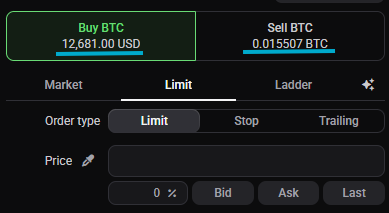 🔍 Click the image to see a larger version
When you open the trading terminal for a pair, the amount field usually lets you enter the size in either currency: how much BTC you want, or how much USDT you’re willing to spend. Both describe the same order, just from opposite ends of the pair. If a number looks off, check which currency the field is actually set to before assuming the size is wrong.
🔍 Click the image to see a larger version
When you open the trading terminal for a pair, the amount field usually lets you enter the size in either currency: how much BTC you want, or how much USDT you’re willing to spend. Both describe the same order, just from opposite ends of the pair. If a number looks off, check which currency the field is actually set to before assuming the size is wrong.
Quick reference
| Pair | Base currency | Quote currency |
|---|---|---|
| BTC/USDT | BTC | USDT |
| ETH/BTC | ETH | BTC |
| SOL/USDC | SOL | USDC |
Notice ETH/BTC: BTC can be a quote currency in one pair and a base currency in another (BTC/USDT). The label depends entirely on which side of the slash it’s on for that specific pair, not on what the coin is.
Where else this shows up
Realized profit on a closed position is paid out in the quote currency of that pair. If you want the fuller picture of how Altrady calculates profit, break-even, and the other numbers on an open position, see Understanding position info & numbers. For the rest of the terms that come up around positions and portfolios, the Altrady Trading Terms Glossary and Portfolio, Folder & Account Equity Explained cover the neighboring pieces.
Still stuck?
If a pair, balance, or position still doesn’t add up the way you expect, reach out through support chat in the app and the team will walk through it with you.