
Why risk management matters, and how Altrady helps
⭐ Important
Risk rules are a Premium plan feature. See the pricing page to compare.
Risk management is deciding, in advance, how much you are willing to lose, and building that limit into how you trade. It is the part of trading that keeps a run of losses from becoming the end of the account, and it matters more than any single winning trade.
 🔍 Click the image to see a larger version
What risk management means
At its simplest, risk management is the set of limits you place on yourself: how much of your account a single trade can lose, how much you can lose in a day, how large or how leveraged a position can get. None of it predicts the market. It decides what happens to you when the market goes against you, which it will, regularly.
Why it matters more than picking winners
A trader can be right more often than not and still lose everything, if the losses are large enough relative to the account. The math is unforgiving: a 50% drawdown needs a 100% gain just to get back to even. Keeping losses small and consistent is what lets a positive edge actually play out over many trades, instead of being erased by one oversized position or a single bad afternoon. Protecting the downside is not the timid alternative to making money; it is the precondition for it.
The habits it supports
Effective risk management is mostly quiet repetition, and disciplined traders tend to share a few habits:
- sizing each trade against a fixed, small share of the account rather than a gut feeling
- defining where they are wrong before entering, with a stop loss
- capping how much a single day can cost, and stepping away after a losing streak rather than chasing it
The value is in doing these every time, especially when it is inconvenient. That consistency is exactly what is hard to hold to by willpower alone.
How Altrady helps
Altrady turns those habits from willpower into settings and guardrails:
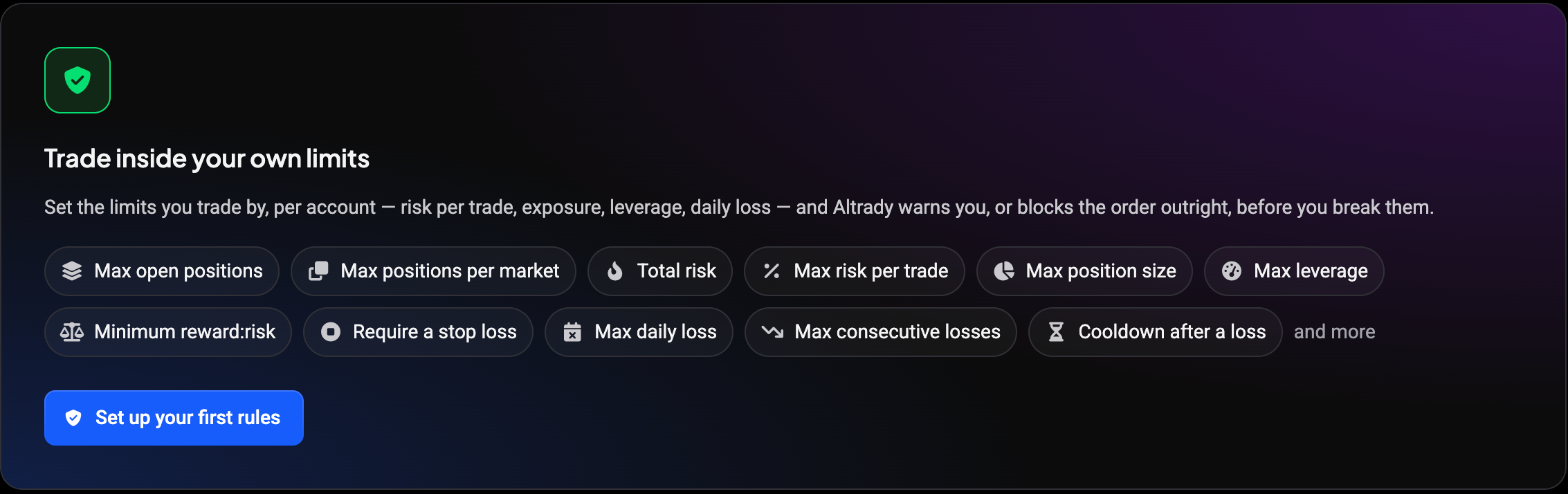
- Risk rules, set per account, let you write your limits down once and have Altrady warn you, or block the order outright, when a trade would cross them: see setting risk rules and how your risk rules are enforced
- smart-order stop losses can be sized against a chosen account risk, so a target like “1% of equity” becomes an actual stop price rather than a rough guess
- the journal and reports show, after the fact, whether your risk stayed where you meant it to: your average loss, your deepest drawdown, your longest losing streak
Altrady provides the tools and the guardrails; the limits themselves are always yours to set and to change.
Still stuck?
If you are not sure what limits to start with, a common starting point is a stop on every trade and a cap on what any one trade can lose, tightened from there as you learn what suits you. Reach out through support chat any time.